Filter traffic based on user's groups
Prerequisites
- a Kubernetes cluster with abcdesktop installed
- use cilium as network provider for your cluster
- An authentication provider with groups support (
LDAP,ActiveDirectoryorOAuth), see authentication section for more details. By default the docker-test-openldap provides groups support.
Note
In this example, we will use docker-test-openldap which is a LDAP service
Use case description
As an organistaion, you may have several departments, such as sales, accounting, IT, etc. And you may want to control access based on department. For exemple, an IT employee shouldn't have access to accounting documents.
With abcdesktop, you can meet these kind of needs by creating rules bases on the groups to which users belong.
---
config:
  theme: redux-color
---
sequenceDiagram
    actor Philip
    Philip->>Router: Logme in (Philip, password)
    Router->>Pyos: Logme in (Philip, password)
    Note over Router,Pyos: 1. Authentication
    Create participant LDAP
    Pyos->>LDAP: BIND LDAP_SEARCH Philip
    destroy LDAP
    LDAP->>Pyos: dn, cn, group=shipcrew
    Note right of Kubernetes: Cilium Policy
    Pyos->>Kubernetes: (option) Create user secrets
    Kubernetes->>Pyos: (option) Secrets created
    Pyos->>Router: User Philip JWT
    Router->>Philip: User Philip JWT
    Philip->>Router: Create Desktop (User Philip JWT)
    Note over Router,Pyos: 2. Create a desktop
    Router->>Pyos: Create Desktop (User Philip JWT)
    Pyos->>Kubernetes: Create Philip POD YAML
    Kubernetes->>Pyos: POD Created
    Create participant PodPhilip
    Note right of PodPhilip: shipcrew=true
    Kubernetes->>PodPhilip:
    destroy Kubernetes
    Kubernetes->>Pyos: Philip Pod is Ready
    destroy Pyos
    Pyos->>Router: Desktop Philip JWT
    Router->>Philip: Desktop Philip JWT
    Router->>Philip: Connected
    Create participant Facebook
    PodPhilip->>Facebook: Access Granted #10004;
    destroy Facebook
    Facebook->>PodPhilip: OK
    Philip-->PodPhilip: Established
    Create participant Youtube
    PodPhilip--xYoutube: Drop #10006;
How does abcdesktop manage groups
Let's assume that the users present your authentication system are already affected to groups. In our example, we have Philip J. Fry a.k.a. fry, and Hubert J. Farnsworth a.k.a. professor, respectively members of ship_crew and admin_staff groups (cf https://github.com/rroemhild/docker-test-openldap).
Once authenticated, abcdesktop control plane reads the user's infos, and will create the user's pod with its groups specified as labels.
kubectl get pods -n abcdesktop
NAME                            READY   STATUS    RESTARTS      AGE
console-od-7f548d74fd-48rpv     1/1     Running   0             2d19h
fry-3c9e8                       3/3     Running   0             45h
memcached-od-796c455cd-hqhlb    1/1     Running   0             2d19h
mongodb-od-0                    2/2     Running   0             2d19h
nginx-od-6657dd8c9-c979g        1/1     Running   0             2d19h
openldap-od-6f4797f9d-86jdd     1/1     Running   0             2d1h
professor-0ecf4                 3/3     Running   0             44h
pyos-od-68776fb486-69x5q        1/1     Running   0             2d
router-od-867f5576dd-p9hj5      1/1     Running   0             2d19h
speedtest-od-78cdbdd9c6-vphfl   1/1     Running   0             2d19h
Run a describe pod command on both user pod to check if the group label is present.
show details
kubectl describe pod fry-3c9e8 -n abcdesktop
[...]
Labels:         abcdesktop/role=desktop
                access_provider=planet
                access_providertype=ldap
                access_userid=fry
                access_username=philip-j.-fry
                broadcast_cookie=202f5459d1a35e54d149b75795f269796cdd78c520e4e412
                cn-ship_crew-ou-people-dc-planetexpress-dc-com=
                ipsource=10.0.2.216
                labeltrue=true
                netpol/ocuser=true
                pulseaudio_cookie=8d8cec68f8647887efdcd1bddb09db6a
                service_broadcast=29784
                service_ephemeral_container=enabled
                service_filer=29783
                service_graphical=6081
                service_init=enabled
                service_pod_application=enabled
                service_printerfile=29782
                service_sound=29788
                service_spawner=29786
                service_webshell=29781
                shipcrew=true
                type=x11server
                xauthkey=2d1afb247f156987dc65ae72bcc0f4
[...]
kubectl describe pod professor-0ecf4 -n abcdesktop
[...]
Labels:         abcdesktop/role=desktop
                access_provider=planet
                access_providertype=ldap
                access_userid=professor
                access_username=hubert-j.-farnsworth
                adminstaff=true
                broadcast_cookie=315066f64d9c59b70ce5f0c7d86f10079b01a78cce44d8c7
                cn-admin_staff-ou-people-dc-planetexpress-dc-com=
                ipsource=10.0.1.22
                labeltrue=true
                netpol/ocuser=true
                pulseaudio_cookie=b8c096a27cad70c114ed81ab4c4da3a1
                service_broadcast=29784
                service_ephemeral_container=enabled
                service_filer=29783
                service_graphical=6081
                service_init=enabled
                service_pod_application=enabled
                service_printerfile=29782
                service_sound=29788
                service_spawner=29786
                service_webshell=29781
                type=x11server
                xauthkey=f7e335f429be8bd8e82c48df775fb0
[...]
You should see labels shipcrew=true for fry and adminstaff=true for professor
Create access rules based on groups
To monitor pods incoming (ingress) and outgoing (egress) traffic in Kubernetes, we ordinarily use NetworkPolicies. But network policies does not offer the possibility to filter based on FQDNs, you can only filter by IPs. So that means, if the service you want to grant access to has more than one IP, you need to specify all IPs in the filter, it becomes even worse if it has dynamic IPs that are constantly changing.
This is why we use cilium as network provider for our cluster, so that we can apply CiliumNetworkPolicies. Those are very similar to the standard network policies but provides fuctionalites that are not yet supported, like DNS based rules.
Warning
It is important to keep in mind that CiliumNetworkPolicies operates on a whitelist basis. That means that once an egress rule is applied, everything that is not clearly indicate as authorized is forbidden.
In our example, we will allow users from the shipcrew group to access Facebook, and users from the adminstaff group to access Youtube.
First create a file called netpol-allow-facebook-shipcrew.yaml and paste the following content
apiVersion: cilium.io/v2
kind: CiliumNetworkPolicy
metadata:
  name: allow-facebook-shipcrew
  namespace: abcdesktop
spec:
  endpointSelector:
    matchLabels:
      shipcrew: "true" # Selector based on group label
  egress:
  - toEndpoints:
    # Allow all DNS resolutions
    - matchLabels:
       "k8s:io.kubernetes.pod.namespace": kube-system
       "k8s:k8s-app": kube-dns
    toPorts:
      - ports:
         - port: "53"
           protocol: ANY
        rules:
          dns:
            - matchPattern: "*"
  - toFQDNs:
      # Add here all the FQDN patterns you want to grant access to
      - matchPattern: "*.facebook.com"
      - matchPattern: "*.xx.fbcdn.net"
    toPorts:
      - ports:
         - port: "80"
           protocol: TCP
         - port: "443"
           protocol: TCP
Save and apply it by running the following command
kubectl apply -f netpol-allow-facebook-shipcrew.yaml -n abcdesktop
ciliumnetworkpolicy.cilium.io/allow-facebook-shipcrew configured
Now you can check if the policy exists by running this command
kubectl get ciliumnetworkpolicy -n abcdesktop
NAME                       AGE
allow-facebook-shipcrew    27h
Your pod should now have access to Facebook and nothing else
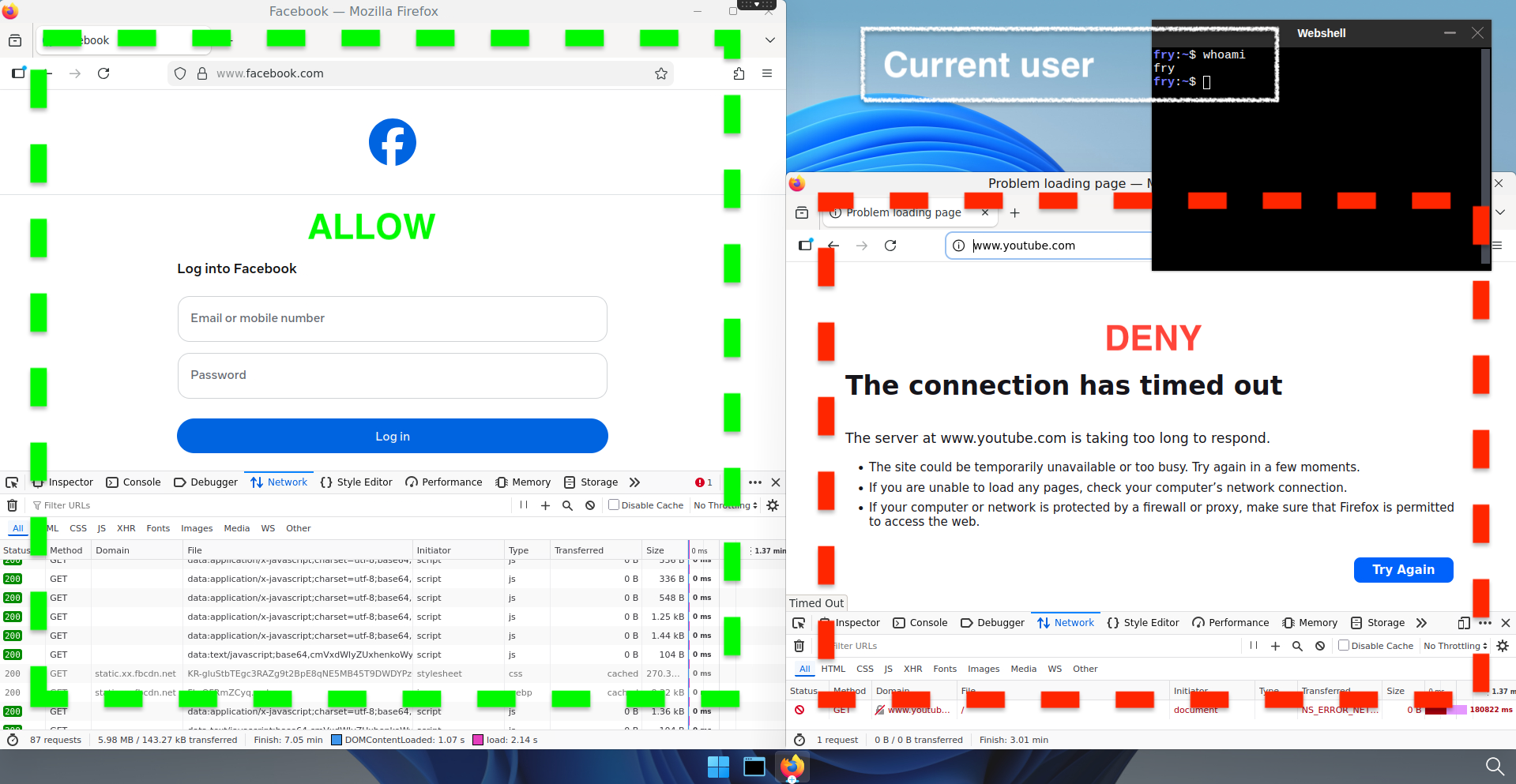
Now create a file called netpol-allow-youtube-adminstaff.yaml and paste the following content
apiVersion: cilium.io/v2
kind: CiliumNetworkPolicy
metadata:
  name: allow-youtube-adminstaff
  namespace: abcdesktop
spec:
  endpointSelector:
    matchLabels:
      adminstaff: "true" # Selector based on group label
  egress:
  - toEndpoints:
    # Allow all DNS resolutions
    - matchLabels:
       "k8s:io.kubernetes.pod.namespace": kube-system
       "k8s:k8s-app": kube-dns
    toPorts:
      - ports:
         - port: "53"
           protocol: ANY
        rules:
          dns:
            - matchPattern: "*"
  - toFQDNs:
      # Add here all the FQDN patterns you want to grant access to
      - matchPattern: "*.youtube.com"
    toPorts:
      - ports:
         - port: "80"
           protocol: TCP
         - port: "443"
           protocol: TCP
Save and apply it by running the following command
kubectl apply -f netpol-allow-youtube-adminstaff.yaml -n abcdesktop
ciliumnetworkpolicy.cilium.io/allow-youtube-adminstaff configured
Now you can check if the policy exists by running this command
kubectl get ciliumnetworkpolicy -n abcdesktop
NAME                       AGE
allow-facebook-shipcrew    27h
allow-youtube-adminstaff   27h
Your pod should now have access to Youtube and nothing else
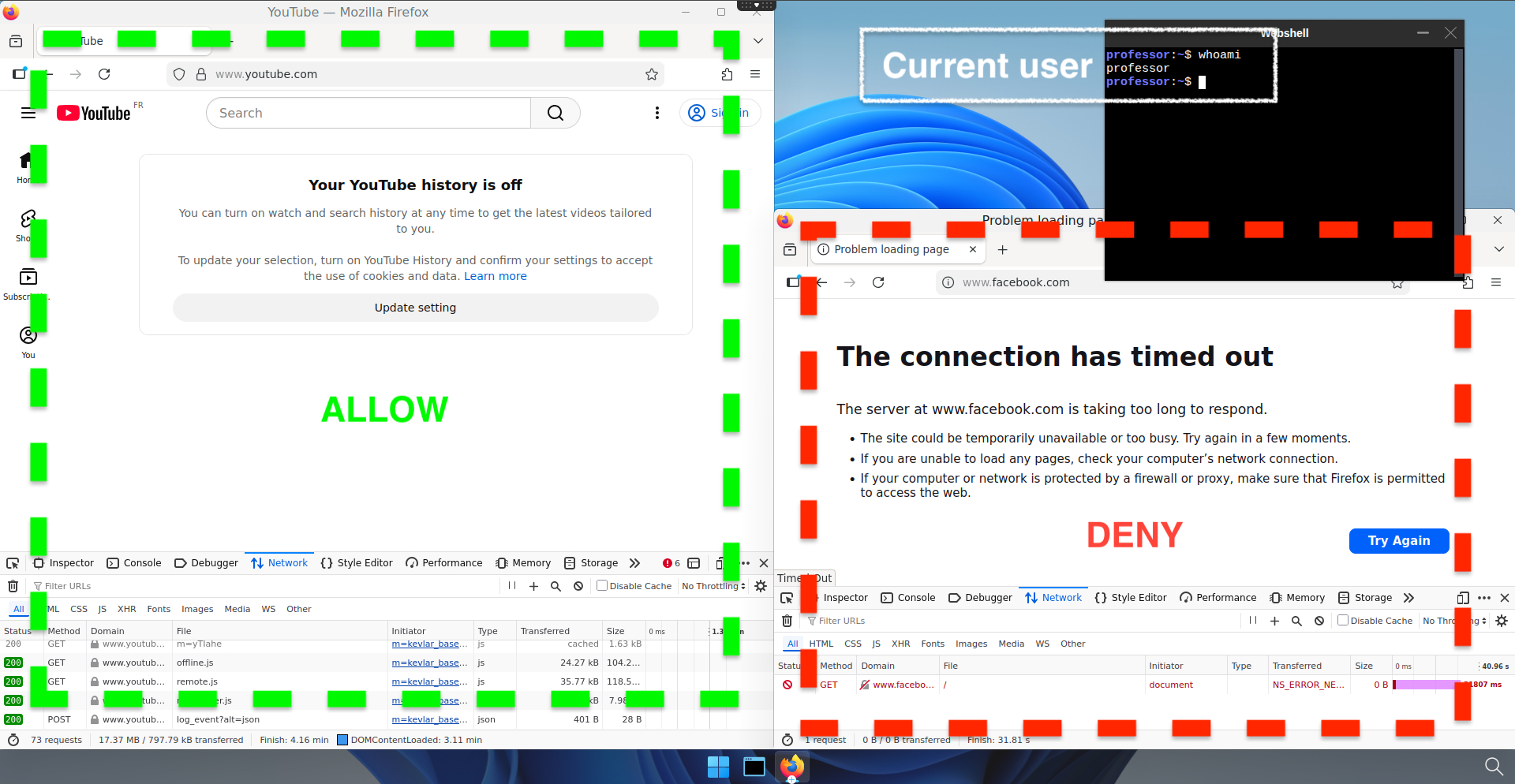
Great ! Now you can manage your organization's network access based on user groups.